
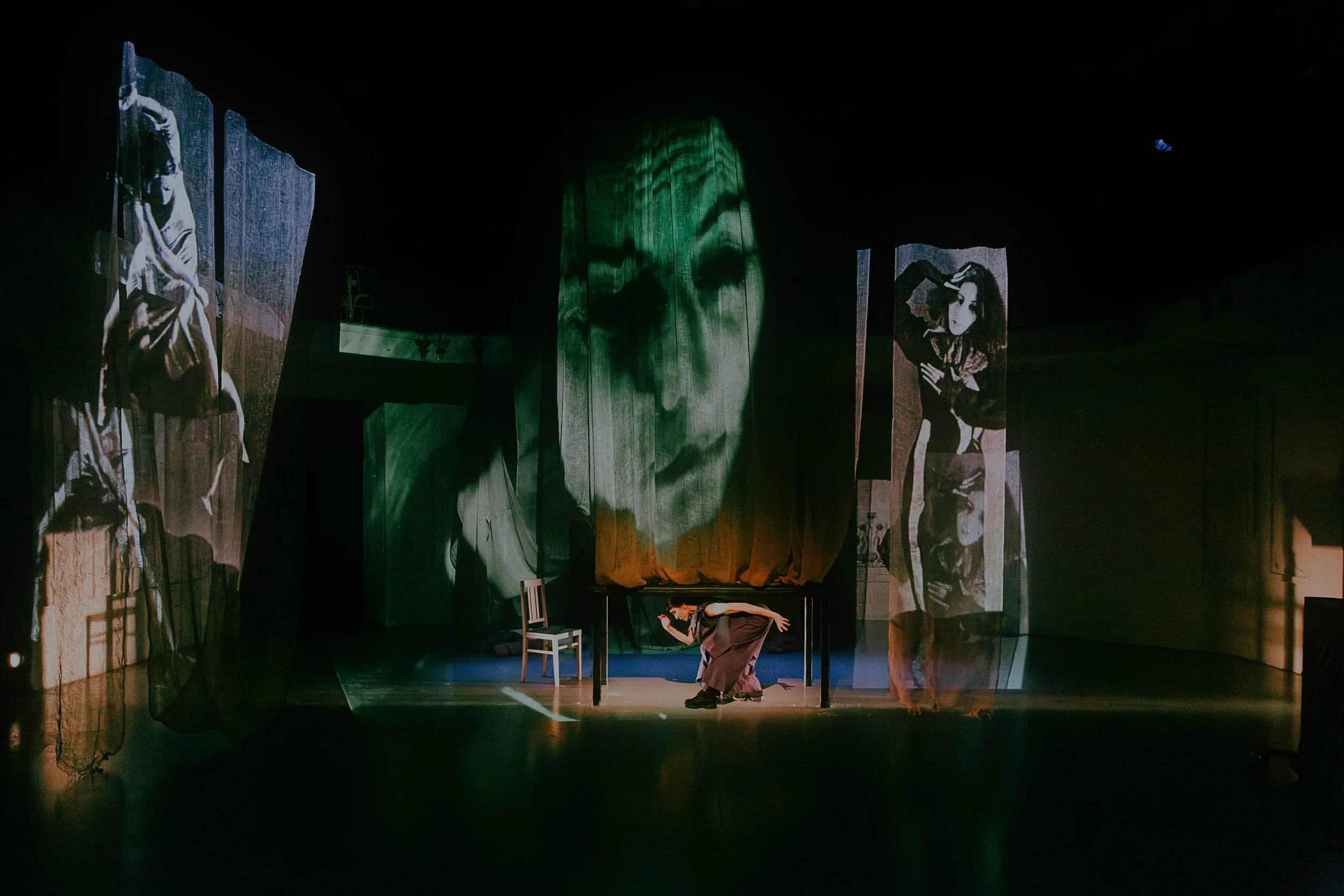
© Hannah Fasching.
Solo - Duration : 55 Min.
= > Download Artistic Dossier
Prodution and Touring Management:
-
March, 20 & 21, 2026 - Projekttheater Dresden (DE)
Premiere - February, 5- 7, 2026 - Nestroy Theater Hamakom, Vienna (AT)
-
TANZ.AT - 10. February 2026 - Barbara Freitag - “Loulou Omer :„HIStorieS – Angelus Novus“ (use translate tool in search bar)
Online Merker - Die internationale Kulturplattform - 7. February 2026 - Rando Hannemann - “Loulou Omer :„HIStorieS – Angelus Novus“ (use translate tool in search bar)
-
Concept Text, Choregraphy, Performance: Loulou Omer I Music: Loulou Omer, Henry Purcell I Dramaturgy & Images: Tal Omer I Light, Video, Technik: Bartek Kubiak I Off-Voice: Goran Rebić, Loulou Omer I Sound: Gustavo Petek, Yasir Ipek I Costumes & Make-up: Sophie Baumgartner I Scenography: Loulou Omer mit Sophie Baumgartner und Bartek Kubiak I Vocal Coach: Nataša Mirkowic I Production Assistant: Ruggero Mannucci I Administration: Thomas Licek
-
HiStorieS – Angelus Novus is supported by the City of Vienna, Kulturabteilung der Stadt Wien (MA7)
With the kind support of Liquid Loft, Bears in the Park, Tanz Company Gervasi, Bildrecht.
In cooperation with the Theater Nestroyhof Hamakom.
HiStorieS - Angelus Novus
HiStorieS – Angelus Novus is the expanded multidisciplinary version of Fast ein Wunder – Reenacting Gertrud Kraus.
The original work was conceived as a tribute to Gertrud Kraus, a major figure of Expressionism and of the Viennese avant-garde during the interwar period. Although this choreographer is closely connected to Loulou Omer’s family history, her influence on Omer’s own artistic trajectory remained for a long time unacknowledged, operating at an almost subterranean level. The piece therefore explored both the work and life of Gertrud Kraus, while opening a broader reflection on memory, forgetting, chance, and destiny.
With HiStorieS – Angelus Novus, this research takes on a new dimension. Drawing on Paul Klee’s Angelus Novus and on Walter Benjamin’s interpretation of the image in his theses “On the Concept of History,” the piece shifts toward a broader inquiry into cultural heritage, our relationship to history, and the ways in which its ruins, ruptures, and forms of violence continue to resonate in the present.
For Benjamin, the “single catastrophe” perceived by the “Angel of History” was inseparable from the rise of fascism in Europe. A century later, this catastrophe seems to reappear in other forms, across many parts of the world, and with particular intensity in the Middle East. Without reducing these correspondences to a single or univocal reading, the piece brings into view possible resonances between the catastrophes of the past and the fractures of the present.